

Get in touch
15-17 Green Lane, Small Heath,
Birmingham, United Kingdom, B9 5BU
Email: [email protected]
Phone: 0121 772 0858
Job Enquiries: 079680 76771 (Richard)


The latest in our series on sustainable material use, this article provides some examples and proofs of concept, showing what can be achieved by building with recycled materials. As a demolitions contractor, we see plenty of material go to landfill, only to be replaced with a building made from the same.
Saving and salvaging the materials from demolition to use in new projects reduces the environmental impact of the construction industry and sets an example for the industry to follow. This article is intended to offer inspiration for building with recycled materials.
The Cabana Floripa is a treehouse cabin on the northern end of Florianopolis island, off the coast of Brazil. This recycled house was built intuitively by Uruguayan visual artist Jaime as part of the Casa Arte complex.
The cabana’s structure uses salvaged wood, including beams, window frames and floorboards from over sixty demolished houses in the area, which would otherwise have been thrown away. Each room features many reclaimed window frames, allowing a huge amount of light in, and colourfully painted walls and features.
The floors on the ground floor are tiled with reclaimed ceramic tiling, giving a patchwork effect. Shelves and other features are made from collected driftwood.
The whole complex is built with the principle of environmentally friendly, low-waste practices. One excellent feature is the use of wine bottles in the concrete walls. This lowers the amount of concrete used by filling space with beautiful blue and green glass which shines in the sunlight.
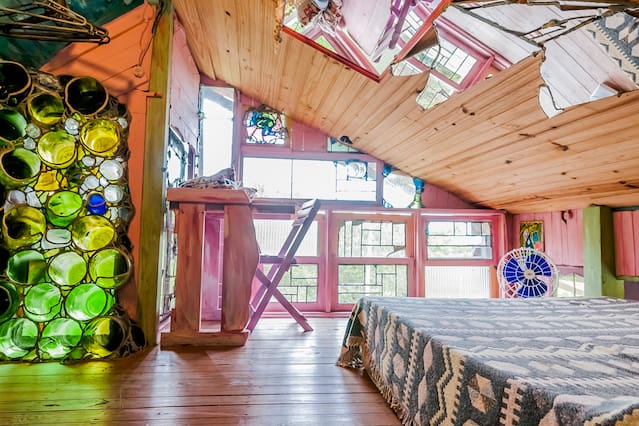
All of these materials can be viewed through glass panels built into the walls so that visitors have an understanding of how this building will inform future sustainability and waste-reduction projects.
The project also decorated using 200 rolls of brand new wallpaper which had been discarded by department stores to make room for Christmas decorations.
The whole build took 11 months, but was 5 years in design, collaborating with undergraduates and architects in the area.
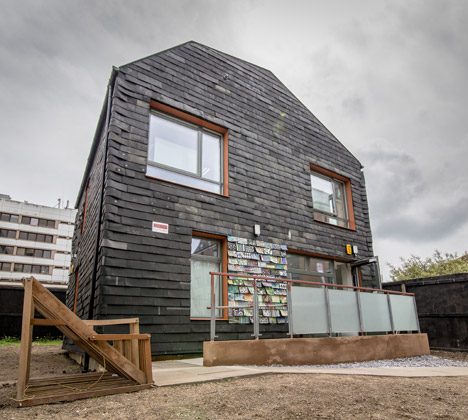
The Waste House is a research facility and design workshop built in 2014 for the University of Brighton’s Faculty of Arts using 85% waste materials. The first thing you notice about The Waste House is the exterior weatherproof cladding, which is made from 2000 used carpet tiles.
The house is built as a live experiment, intended as a permanent structure but with inbuilt monitoring to assess how it retains heat. The success of this experiment is already in evidence, as the building has attained an EPC ‘A’ rating.
Designed by a senior lecturer and then director of the BBM architecture studio, Duncan Baker-Brown, the Waste House is the first permanent structure made from ‘rubbish’ in the UK.
“There have been a lot of other projects where people have built sheds or temporary things out of rubbish, but to get full building regulations and planning approval is a first”
– Baker-Brown, quoted in Dezeen
The foundations were made from reclaimed slag from a blast furnace, which was ground into granules and supported using a framework of plywood beams, columns and timber, salvaged from a nearby demolition.
A permanent vapour-control membrane surrounds the house, made entirely from waste vinyl banners from exhibitions. This acts similarly to a damp course, preventing a buildup of moisture in the building.
The most experimental part of this structure is the insulation. The walls are made from panels which are stuffed with different waste materials, in order to measure each material’s heat recovery properties.
Even in our own city, there are examples of buildings made out of recycled materials and eco-friendly practices. In Balsall Heath, not far from PBM Contractors’ head office, the Zero Carbon House uses 14 different reclaimed materials, as well as rainwater harvesting and solar power to generate as much energy as it consumes.
The original structure was a Victorian townhouse, which was retrofitted by the owner, architect John Christophers to create an improved, fossil-free home for his family. Using space, light and materials, Christophers worked independently on the home to achieve both high environmental standards (the building is a Level 6 Sustainable Home) and high architectural and visual impact. Sustainable buildings can be beautiful.
Hemp ropes for stair rails, which are biodegradable and use much less energy than stainless steel; Read more about the Zero Carbon House, Birmingham.
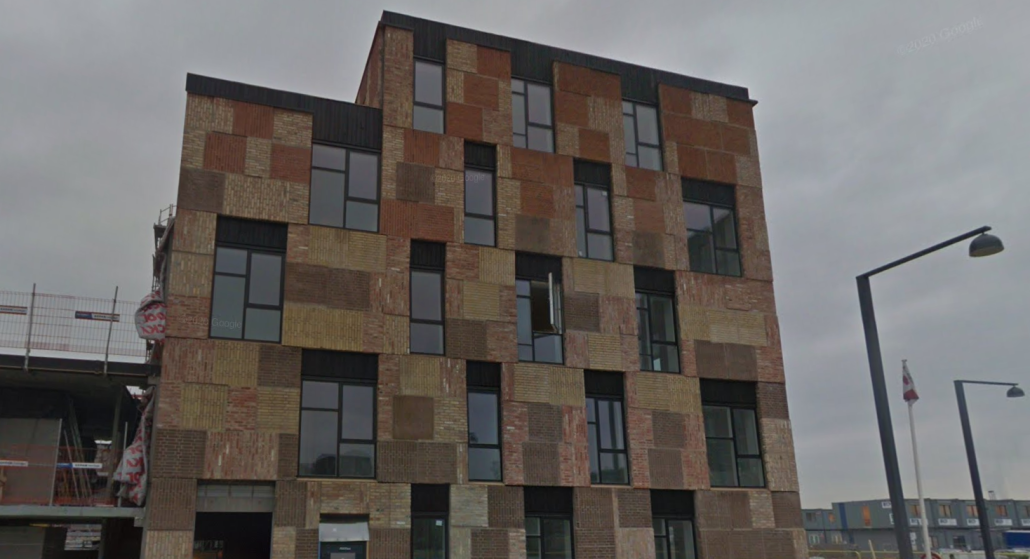
A housing project in Copenhagen known as Resource Rows, has mainly been built using recycled materials. Larger than the other buildings mentioned in this article, Resource Rows is part of the Ørestad Syd development, with 92 homes in two rows of three-storey terraced houses and two five-storey tower blocks.
The core idea of the project is to build homes from recycled materials, and this is highly visible in the facade of the buildings.
This is made from 3m2 panels cut from old brick walls, reusing both bricks and mortar, to create a multicoloured texture.
The panels were framed with steel or backed with concrete to hold them together, as 1960s bricks used cement-based mortar that would crack if reused brick by brick.
By ‘harvesting’ material from buildings due to be demolished, the architect Anders Lendager believes reclamation and ‘upcycling’ is the future of construction.
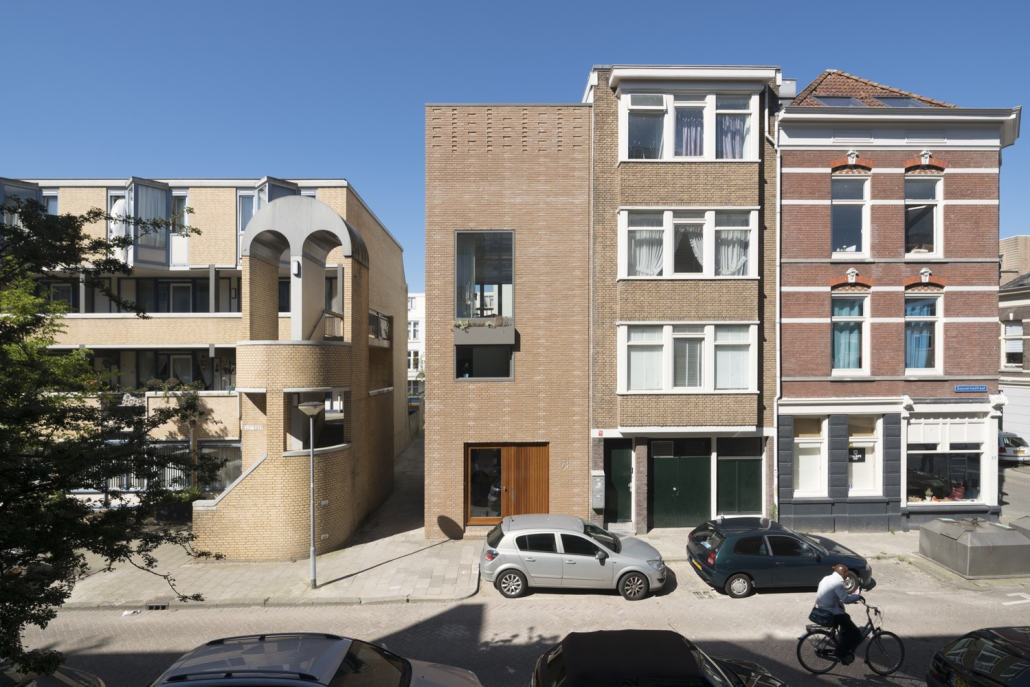
Architects designing their own sustainable homes are those with the most freedom in this arena, but their suppliers play an important part. Amsterdam company Stone Cycling manufactures waste-based bricks, slips and tiles in a range of colours and textures using recycled construction materials.
Their products were used by Dutch architects Nina Aalbers and Ferry in’t Veld, who wanted to match the brick facades of their neighbours when designing their home in Rotterdam.
For this building, StoneCycling crushed and reconstituted approximately 15 tonnes of waste, including brick rubble, ceramic and glass, to create caramel-toned bricks that would fit with the look of other buildings on the street.
The company offer to create bricks and slips in many colours and shapes, mixing crushed debris of different colours to find the right shade for the design.
In the Netherlands, like in the UK, brick facades are the most popular aesthetic for homes. Using reclaimed or reconstituted bricks can dramatically improve the carbon footprint of housing construction.
In all of these examples, architects and designers (and artists) chose their materials carefully to ensure they were creating sustainable buildings. The construction industry in the UK accounts for 19% of UK greenhouse gas emissions, and construction materials account for 32% of landfill content. Recycled building materials are a key part of the UK’s net zero journey, and it’s time to start considering the sources of construction materials.
Approach factories or businesses for waste such as timber offcuts from floor factories, carpet waste and fabric remnants. This is mutually beneficial as it reduces waste from the business and is a cheap source of reclaimed material.
Demolition contractors like us can help with resource recycling, sending construction waste for sorting and processing into new, usable products. Get in touch with PBM Contractors to get a quote for demolition and discuss material reuse.
15-17 Green Lane, Small Heath,
Birmingham, United Kingdom, B9 5BU
Email: [email protected]
Phone: 0121 772 0858
Job Enquiries: 079680 76771 (Richard)

 Understanding the Demolition Process: From Soft Strip to Crushing